

12/4/1024
“Trap” has two meanings in OSR culture:
#1 A Big Dangerous Puzzle
For a lot of OSR gamers, “traps” are really more like elaborate puzzles. “Trap means “trigger.” Example:
“The room is trapped to spew fire if the stone tiles marked with an X are walked on.”
“The room is triggered to spew fire if the stone tiles marked with an X are walked on.”
The trap (or trigger) is usually blatantly telegraphed (the X on the tiles) and the problem can be solved. Its meant to be solved. The players can avoid the tiles marked with an X, and perhaps utilize the trap later on different enemies to catch them on fire.
Maybe its difficult to solve (there’s a lot of Xs, you’ll need to either be acrobatic or find a way to cross without touching most of the floor).
Maybe its easy to avoid (there are scorch marks for exactly where the fire spouts are and there “safe areas” in the room untouched by them).
Traps like this are better off as set-pieces in a room. They usually require the room to be set up in such a way to enable the trap/puzzle to be front-and-center, and so are made greater through pre-planning.
These kinds of traps should NOT be on random encounter tables.
#2 A Sudden Punch in the Face
For the other chunk of gamers, “trap” means “attrition”. Not just of items and hit points, but for patience.
10ft poles to tap every tile as you explore the dungeon, because the tiles here are NOT marked with an X. Unless you search the room, or get really specific with your words, you WILL trigger the trap.
It’s also similar to the way a lot of traps in video games work.
In Baldur’s Gate 2, unless you have a thief out there checking for traps, you’re going to get hit with a whole mess of consequences very frequently.
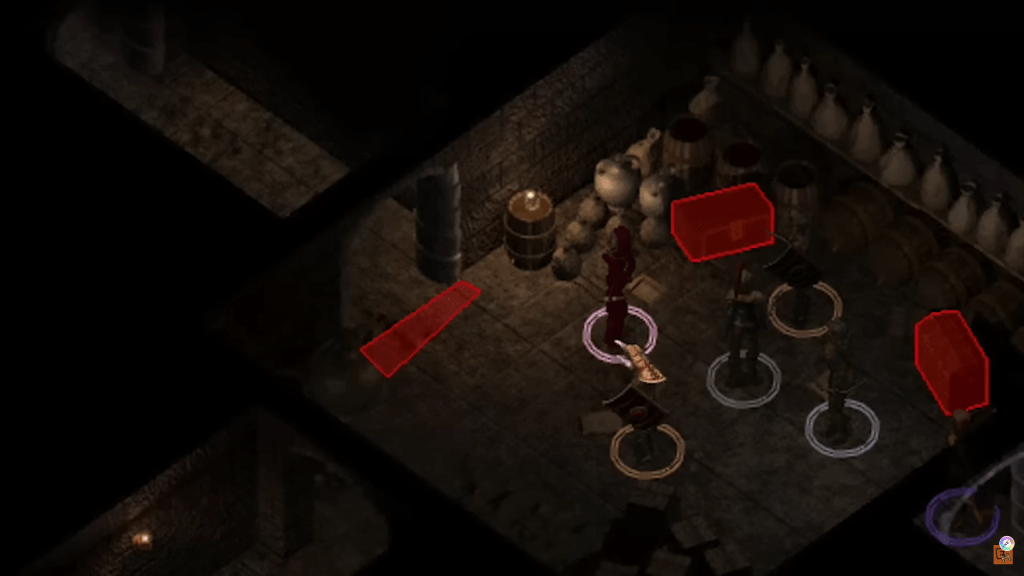
Screenshot taken from “Baldur’s Gate: Durlag’s Tower – Part 2: Dungeon Master’s Guide – Design Club” by Extra Credits on YouTube.
Similarly, in Darkest Dungeon, traps are just invisible until stepped on or scouted out by a character ability.
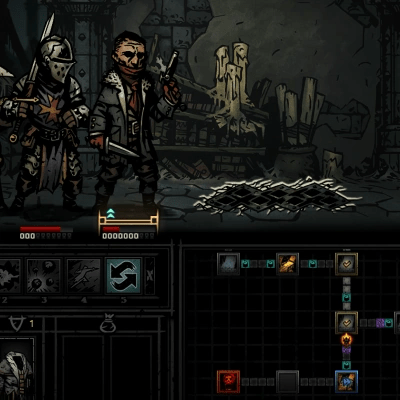
Image taken from the “Darkest Dungeon Wiki.”
Pre-setting traps like these in your dungeons as a GM either works to keep the players on their toes constantly and have them work incredibly slowly (whether or not they will learn the lesson, and/or waste a ton of time being cautious is another article entirely), or just infuriates the players.
Contrary to my previous statement, I like the jack-in-the-box, wrong-step-wrong-time, spikes-in-the-floor-walls-and-ceiling traps.
I think their thematic and they have a place in play.
So, don’t preset them, just add them to your encounter tables
First off, let the players KNOW that traps are a possible random encounter. Player’s are not stupid, and they know random encounters exist, they know there’s an approximate timer for them, and they know that when you start rolling a lot of dice behind the screen that an encounter is on the way.
Once they know that rolling those dice does not necessarily mean a monster is on the way, but that there’s a chance that a death pendulum could be swinging at them, they’ll be just as antsy.
This also stops a major problem with random encounters in some systems: players can’t just hide the second a random encounter is anticipated.
In this case, hiding doesn’t solve the problem and just wastes time burning down torches and pushing them closer to another random encounter.
Where to place them
So, you just rolled up your first random encounter trap, where does it go in the dungeon? The same place a monster would! Roll for encounter distance as normal and place that far away in any direction.
“What if the players have already walked that way?”
Well, if its a random pressure-plate-stone in the floor then they just might not have stepped passed it. The odds aren’t impossible that they may have just missed it, no matter the circumstance.
I do have one rule of thumb when it comes to placing random traps: never place them in rooms players have fully searched.
That, I feel, is genuinely not fair.
If there’s no place to put it, do all the rolling for it, but don’t put it in the game. They got off easy, but they don’t know that!
Minimize player frustration with reaction time
Getting punched in the face sucks, and so does not being able to anticipate it. Telegraphing danger is a core tenant of the OSR, but the whole point of these kinds of traps is to NOT telegraph them. They are supposed to be surprises!
Instead I suggest a new motus operandi:
Reaction time. Here’s an example:
GM: Joseph make a Senses check (or save vs. traps).
Joseph: *rolls dice* Failed.
GM: The brick beneath your boot sinks down slightly, you hear a click. What is your first reaction?
Joseph: Get the hell out of there!
GM: Which way?
Joseph: Back the way I came!
GM: Give me another Senses check (or save vs. breath weapon).
Joseph: *rolls dice* Passed.
GM: You pull back just as the bricks in the wall to your right fall away to reveal a series of holes, sending darts where you were. You passed so you escape without suffering any damage. The trap does not seem to re-arm.
This method gives the player two chances to chances to save their skin from the trap.
The initial roll gives them the information they need to make a decision. If they fail it, they simply do not get enough information.
The second roll is the one that actually determines if they’re going to suffer the effects of the trap or not.
Here’s the same example, but assuming he passed his initial save:
GM: Joseph make a Senses check (or save vs. traps).
Joseph: *rolls dice* Passed.
GM: The brick beneath your boot sinks down slightly, you hear a click. You can hear a mechanism turning inside the wall to your right. When you look over you see the bricks are falling away and tiny holes loaded with darts are left behind. What is your first reaction?
Joseph: Get the hell out of there!
GM: Which way?
Joseph: Back the way I came!
GM: Give me another Senses roll, this time with +5.
Joseph: *rolls dice* Passed, but only with the bonus.
GM: A pass is a pass. You pull back just as the bricks in the wall to your right fall away to reveal a series of holes, sending darts where you were. You passed so you escape without suffering any damage. The trap does not seem to re-arm.
Success early on means a bonus for the second save. This also depends on the decision they make with the agency they are given.
What would have happened should he fail twice?
GM: Joseph make a Senses check (or save vs. traps).
Joseph: *rolls dice* Failed.
GM: The brick beneath your boot sinks down slightly, you hear a click. What is your first reaction?
Joseph: Get the hell out of there!
GM: Which way?
Joseph: Back the way I came!
GM: Give me another Senses check (or save vs. breath weapon).
Joseph: *rolls dice* Failed. These dice are terrible!
GM: You pull back just as the bricks in the wall to your right fall away to reveal a series of holes. You stumble, a linger too long as a volley of darts slams into your side. You suffer d8 damage. The trap doesn’t seem to re-arm.
This method does not mean the player is guaranteed escape. They can still get caught out high and dry. But, they at least feel as if they had some more agency then a single roll to determine everything.
What if Joseph did a different course of action?
GM: Joseph make a Senses check (or save vs. traps).
Joseph: *rolls dice* Passed.
GM: The brick beneath your boot sinks down slightly, you hear a click. You can hear a mechanism turning inside the wall to your right. When you look over you see the bricks are falling away and tiny holes loaded with darts are left behind. What is your first reaction?
Joseph: I drop to a knee and bring my shield up facing the darts!
GM: No need for a roll, good decision making. A volley of darts slams into your shield. The trap doesn’t seem to re-arm.
Players should be allowed to ignore the effects of most traps if they think quickly enough. Maybe for a death pendulum this is by going prone instead of running away, or with a flamethrower trap by finding a way to quickly extinguish the starter flame.
You don’t have to come up with a solution for them to choose before hand, but if its not, “I run away” and makes since, I usually give it to them.
These random traps are static in the world and tend to be single use
Once you’ve rolled it up, that trap is there now. It shouldn’t follow the players around, and if the players have out their 10ft poles or similar equipment to check each room they enter, they can discover it/trigger it without needing to get into reaction time.
The goal of any mechanic in dungeon crawling is reward smart play. If they outsmart the trap, let them win.
Likewise, a lot of these random encounter traps should be single use.
Not all them, but I recommend most of them are. They need to be reset in some way by the residents of the dungeon.
This stops the trap from becoming a dog-and-pony-show onto itself when it should be a simple, sudden, side thing. More will arrive as the encounter table is rolled on, its okay if this one goes away quickly.
The initial roll replaces telegraphing
Both the complicated puzzle traps and random-gotcha traps are fun (don’t let anyone tell you otherwise), but they can’t be used in the same way without causing frustration.
If a player knowingly steps on a stone tile marked with an X, they only get one roll to dodge the consequences of their actions. The telegraphing takes the place of the initial roll.
Just like an initial roll to grasp the situation you’re in, there is not guarantee that a telegraphed trap will be correctly interpreted by the players.
So, use both. If you do it right, it will only make things more exciting.
Thank you so much, everyone!
Until we meet again,
GOOD LUCK ON YOUR ADVENTURES


 Ward Against Evil

Leave a comment