
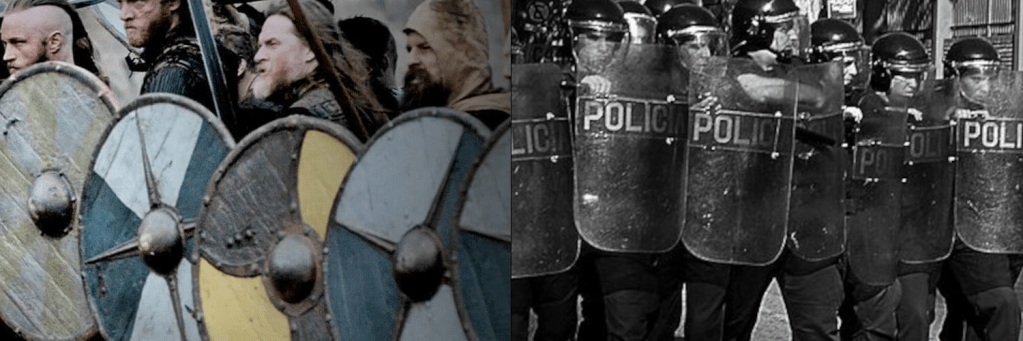
https://quirkworthy.com/wp-content/uploads/2014/04/riot-shields.jpg
https://www.reliks.com/viking-shield-wall/
9/8/2025
The reason I put “Riot Control” in parenthesis is because that’s a term the public would be more familiar with. My actual training and experience is with “Civil Disturbance Operations” (CDO) in the US Army National Guard.
The Purpose of a Shield Wall
Shield walls have multiple purposes:
- Provide mobile cover for warriors under attack from projectiles
- Limit opposition’s decision making by cutting off territory
- Create a defensive perimeter from which allied command and control can be restored
Mobile Cover: In fantasy and our own history, we can imagine shield walls approaching castle walls before going in for the final assault. Just as well, under a hail of arrows, a group of warriors might quickly bring their shields together to protect them from the blows.
Limit Decision Making: Shield walls are walls. You cannot just get through them. By adding walls to the battlefield you are changing how the opposition has to see the battlefield. Think of them like a line of pawns in chess. You don’t have to go around, but going straight through will get you all tied up in problems.
Defensive Perimeter: If things are getting out of hand, and you are losing control of the situation, you can establish a shield wall to get accountability of your men and equipment, as well as provide a safe place for you to regain command.
This is a Wall, No Gaps
A shield wall is a literal wall. You are a shoulder-to-shoulder, tightly fitted together formation. There are no gaps. There is no back-pedals. You will only go forward, if you must move at all, and you will go forward when commanded to do so (more on that later).
This is a flat wall. The flatter the better, with shields interlocked leading towards the middle. Bulges or dips in the wall are places where you are least defended, where warriors are most open to being literally ripped out of formation by the enemy.
You do not take up a lot of space at all. It takes a lot of people to make this formation work. 20 guys couldn’t wall up a city street. Try 40, or 60.

Taken from FM 3-19.15, Figure 4-1. Riot Shield Positions
Being a wall takes both hands. One hand holds the shield, the other hand braces the shield, tilted forward slightly to both better brace the shield and to cause projectiles (rocks, arrows, whatever) to fall farther away from the warrior.
Imagine if your shield only had one hand/arm (and thus pivot point) near its center and someone pushed it near the top or bottom. Bonk! That’s the sound of your helmet or greaves being hit by the tilted shield. Hard.
It’s Not Just the Front Line
As previously mentioned, you are in their tight. The guys behind the front line do not have shields, they have weapons (usually batons). In fantasy, they would probably have shields and weapons, but while the guy in front is focusing on his shield, the guy in back is focusing on his weapon.
If anyone tries to get hands on the shield, or an enemy tries to come up on you in some way, the guy in the back is going to attack over, under, or to the side of your shield. This is the delegation of tasks, you make sure your shield is shielding, they attack for you.
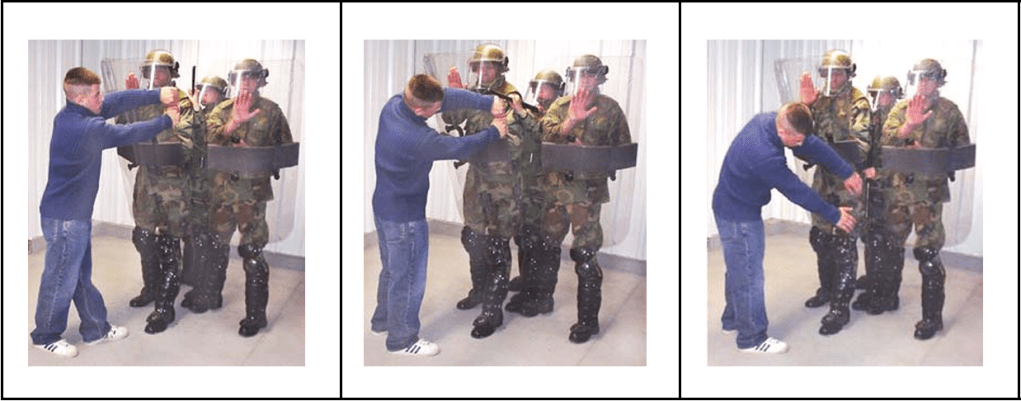
Taken from FM 3-19.15, Figure 4-20. Clearing a Riot Shield
For this reason, as a shieldsman, you will not step forward and “shield bash” people! Congratulations, you just made a bulge in the formation! And what happens if they step back with you and drag you out of the wall? You’re cooked my friend. Better instead to rely on your battle buddy with the baton/sword to take care of them for you.
Who’s behind the weapon guy?
That depends. Sometimes no one. But in a lot of formations, another row of shield guys followed by another row of weapon guys and so on. In the very back (or near the middle in a medieval-fantasy setting) will be medical personnel and officers who will be directing the formation (more on that later).
Assuming this isn’t the modern day, and each of these medieval-fantasy warriors has both a shield and sword, should anyone go down they will be dragged to the back or the formation will move forward to cover down, and another dude with that equipment will fill in. Easy.
Sometimes you’ll have a ranged weapons guy back there (maybe with javelins or a crossbow (it requires less room to shoot than a bow). They’ll usually tap you on the shoulder and say, “take a knee” before they send projectiles over your head. It’s just polite. Then they’ll tap you to stand back up when they’re done.

Taken from FM 3-19.15, Figure 4-21. Tap-Down Technique
The weapon guy is also in charge of making sure you actually stay in line! If a shieldsman is getting ripped out of formation by an enemy, the man behind them grabs their armor and keeps them in place. If a shieldsman is collapsing the line because their nervous or folding, the weaponsman pushes them back out to maintain a flat line. They are the overseer, and in the military they are normally the sergeants.
From what I understand, Roman Republic shield formations were ordered front-to-rear by seniority as well. Probably for the same reason.
Do not be surprised if the senior warrior behind you always has one hand on your armor for exactly these reasons. Control must be maintained.
Obey Orders and Don’t Be an Individual
A shield wall is highly disciplined formation. It is difficult to get non-professionals to do it correctly because the kind of people to volunteer for impromptu warfare or rioting tend to really like being individuals and do not have a clear leader.
The formation moves forward or backward when the commanders orders they will and by a number of steps the commander has ordered. To ensure this, they’ll count out loud in a cadence they are used to or have their sergeants count for them while the front line guys say some battle cry or “step back” with every step.
A formation that moves on its own is one that will dissolve quickly. This is a closed, tight formation. It’s meant for control, not charging the enemy.
When a shield wall forms/reforms, you can hear the clanking of the shields and armor. You will be tossed around. The senior warriors behind you will throw you together, but it will be fast, and you will be ready to move in moments.
Here They Come: Stand Firm
A military-age male with military-grade muscles will really hurt when they are pounding on your shield. You will be bruised by the end of your term. Be aware.
Maintain your discipline, because they enemy will try to tempt you to get sloppy. They will insult you, call you some of the most horrific slurs you’ve ever heard, goad you into striking them, do not. Your job is to be a wall. If you show them your frustration, they will smell blood in the water and focus their efforts on the warrior who is about to make the last mistake of their life.

Taken from FM 3-19.15, Figure 4-12. Strong Side Block (Steps 1 and 2)
Medieval-fantasy militaries will utilize disruptors to break up your formation. A great example is the war-elephant. You, humble shieldsman, cannot stop an elephant. You will, most likely, break and run or back up. Modern militaries use these too. We use tear gas because you, humble shieldsman, can’t stop tear gas. You’ll break formation eventually. Or, at least, it’ll weaken the formation enough that the ensuing assault will break it.
Disruptors don’t have to kill you, they just have to put a hole in the wall. And from that hole, the enemy will flood in.
Dealing with Projectiles
Lastly, what do you do when the opposition is raining arrows down on you? Well, people that are standing tightly in a shield formation take up more space vertically than they do horizontally. A shield going overhead can cover 2-4 men, while a shield held in front can usually only cover one.
If someone throws a molotov cocktail at you, don’t fret! TELL YOUR COMMANDER, and he’ll order a movement to the front or rear. Just walk over/around it buddy. It ain’t that deep.
Things Shield Walls Suck At:
- Turning
- Moving fast
- Staying together after the Commander is neutralized
- Dealing with grenades or similar blast munitions
Thank you for reading!
Until we meet again,
GOOD LUCK ON YOUR ADVENTURES
 Ward Against Evil

Leave a comment