
Image Credit: https://davidleonard-greyhawkmusings.blogspot.com/2021/02/thoughts-on-a1-4-scourge-of-slave-lords.html
2/21/2026
Recently, one of my blog posts was nominated for a Bloggie. I didn’t win one, but I’m glad I was nominated because I was introduced to a whole slew of other blog posts about TTRPGs that were absolutely worth the read. What’s better, a lot of them were turned into little audio-casts on Spotify (of which mine is also on the list, be warned, I was sick at the time of recording) and so I could listen to them going to work.
One of them caught my attention right away: The Anti-Colonial Dungeon. I was confused the title, until I read the first line:
“A few days ago, my friend Habeeb, made his first Tabletop RPG blogpost: the default dungeon is colonial.”
It was a response to another post. So I read that post, and honestly, I’ve got a lot of opinions on this.
The Only Thing Scarier Than a Dragon is a Metaphor
I disagree with the premise of the second article. I think it feeds into a strange habit I’ve seen a lot of people doing over the past few years in the TTRPG sphere, and that’s associating with the monsters in RPGs more than the adventurers.
I think this is because of our innate drive to side with the underdog, or maybe because of growing concept that all the adventurers are roguish criminals and weirdos instead of heroes-in-training. It could also be that in the extrapolation of people’s game worlds because of the neutral evil actions their characters often embark on without consequence, which I feel also leads to abandonment of alignment as well (a point for another time).
Whatever the case, there is this humanization of conventional monsters that often comes with a simultaneous demonization of conventional heroism. I’m referring to the old “orcs aren’t all evil” conversation (which is also a point for another time).
What this boils down to is the evil townsfolk sending out these criminal, roguish, weirdos to steal gold and treasure from the indigenous orcs and goblins in the countryside, often genociding the populace in the process.
And you know, when you put it like that, it’s pretty indefensible. It might be fun, but we really have to do some mental gymnastics to justify why it’s fun.
Why I Think This Is Not a Correct Framing
Let’s ask a few quick questions I have for most people playing conventional game worlds (obviously, in your homebrew game worlds, you make up whatever you want):
- Where is the gold in the dungeons coming from?
- Where does the magic they wield come from?
- What would the monsters do if we did not raid the dungeon?
- Who was here first?
Where is the Gold in the Dungeons Coming From?
Most monsters, are not capable of running a mint. Likewise, most monsters are not hoarding random chunks of gold and silver ore or gold and silver bars fresh from the forge. Similarly, a lot of these monsters do not do trade with “civilization” in such a way that would lead them to have this gold.
They took it or they found it. I doubt a knight or baron just gave the hostile orc clan 10,000gp out of good faith. Maybe with some later political intent, as part of a peace deal, or some other third thing, but probably not out of charity.
So, they aggressed, or somehow managed to take what wasn’t there’s. Does that justify the players by itself? Not always. Especially if its not the player character’s stuff.
In The Hobbit, after Bilbo yaps at the trolls until they turn to stone, they find magical elven swords in the troll’s cave. Foehammer, one is called. Where did they get those? They didn’t make them, that’s for sure!
At this point one could make the argument that the sword Goblin Cleaver was probably used against the trolls allies, and perhaps he was disarming an oppressor. Maybe. And for that reason I don’t think this question alone justifies adventure into a dungeon.
Where Does the Magic They Wield Come From?
In many of the earliest forms of D&D, back even to the original cover art of eldritch wizardry, most monsters got their magic from evil sources. Blood sacrifices, demon lords, archdevils, cosmic entities, necromancy, dark alchemy (like Frankenstein type stuff), etc.
This is dark magic. “Well, it’s a cultural difference.” With something like Necromancy, maybe, depends on the setting. However, in the vast majority of settings, blood magic is frowned upon or banned, along with associated with known inter-planar evil beings.
If their magic is linked to making deals with demons/devils and potentially bringing world-ending beings into this world, that’s problematic. But really, that fits more into the third question:
What Would the Monsters Do If You Didn’t Raid the Dungeon?
Would the monsters just sit in a circle, hold hands, and sing happy songs, or would they raid you? Do these monsters eat people?
Maybe, like the previous question asked, if we didn’t raid them they’d reawaken the Archlich Abbraxus, the Thrice Risen. That sounds like a headache and a half to me, I don’t know about you.
Take for example Mind Flayers and Drow, who are objectively intelligent and logistically minded enough to mint their own coins and create their own treasure. These groups are also some of the most prolific slavers, raiding the service, and performing heinous rituals/eating brains, not in that order.
Who Was Here First?
I keep seeing things that humanity or “civilization” in general is always the one pushing into the wild frontier/hinterlands already thriving with monsters. I do not see a lot of evidence for this?
In the origin stories of most of these settings all the races/species were spread out across the world at roughly the same time. In many old modules, the orcs, goblins, or the like are infiltrating human/elf/dwarf lands and raiding their farms. Often the castles they inhabit are old human/elf/dwarf castles that were abandoned due to lack of use. They are frequently depicted as the invaders.
What Are All These Questions For?
Justification. Casus belli. The reason one goes to war.
If you can’t answer these questions with the monsters looking like saints, then you have your reason. Go to war, my friend.
Can you weasel your way around this? Yes. But why would you other to prove a point?
Why I Think Saying the Default Dungeon is Colonial is a Gross Oversimplification that Hurts their Own Argument
If something being colonial just means that there is resource extraction then you have watered down a term until the horror associated with it no longer has meaning. The evils committed to indigenous people groups around the world? Really just resource extraction, no step 2.
Doesn’t that sound a little trite?
Now, I’m not saying the author of the article intended this, but this is an unintended consequence of the overextrapolation of a concept such as colonization ad infinitum. I also firmly believe that it is not just them doing this, but so. many. people.
Why the Solution for the “Anti-Colonial Dungeon” Was Already There But We Threw It Away Because… Reasons
The article about the “Anti-Colonial Dungeon” (that clearly a lot of people agreed with because it made it nearly all the way to winning the Bloggie) solves a problem that was already solved. One of the earliest, and from what I’ve heard best, early D&D adventures was “Scourge of the Slave Lords.”
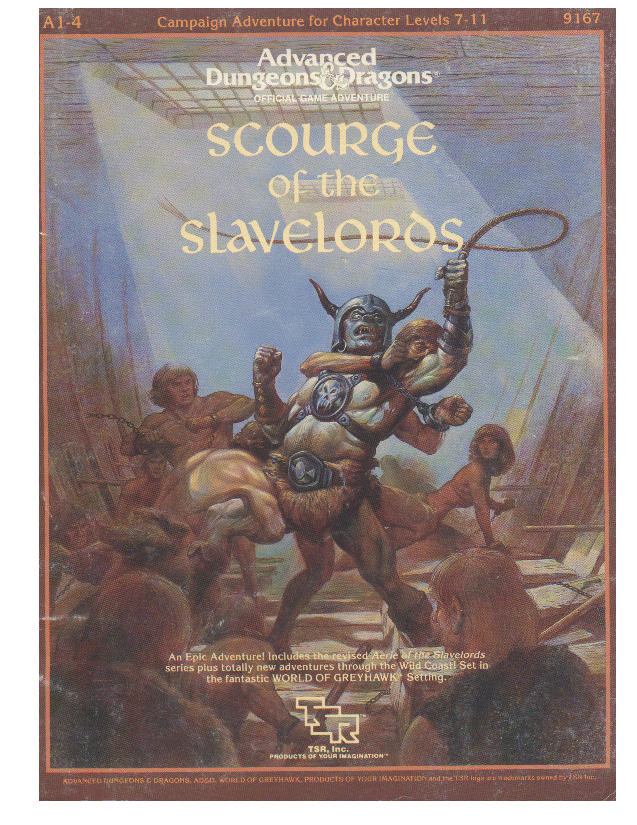
(unrelated, I had an argument with a guy about this cover. He said it was bad it only depicted white people and that it fed into some white fantasy of disempowerment. I asked him if he wanted a book cover with bunch of black people in chains. This also made him uncomfortable. I guess there was no right answer?)
Slave lords huh? Sounds like the kind of stuff the anti-colonial dungeon article talks about.
Resource extraction, forced labor, the destruction of a people, freeing hostages, slave revolts, all of that was already in the game. The problem was we threw it all out as a community!
It used to be common in Monster Manual stat blocks for goblins, orcs, kobolds, and the rest of the monsters to keep slaves, explicitly love torturing people, eat people, hate other races based solely on race (such as elves, dwarves, and halflings), and bullying/oppressing people groups weaker than them (even other orcs, goblins, etc!). We got rid of that because of… ????? So now we have to make it up again on the backend??? And call it a new idea???
We were always fighting “oppressor forces,” we were always warring against “colonialists” foes who stole our gold, magic items, and jewels and (in order to try to get an upper hand on us) they would call on dark magics and powers to try to stop the powers of goodness and hope (hopecore for the win?). But that was thrown out because (and here’s where I rant) for some reason we believe the established system has to be rigged and totally corrupt and we need to have a continuous revolution to abolish it??? AND that ANYONE fighting the established system MUST be misunderstood and/or be the good guys???
It’s not even that these setting’s established “civilization” were perfect either. There were disputes between religions, governments, knightly feuds, insidious cults, treason, heresy, all kinds of stuff. Governments failed the people in many ways which was one of the main reasons adventurers were necessary to close the gaps where knights and barons couldn’t without risking too many of their men that they couldn’t defend the walls should they fail.
It seems silly to me that we’re trying to reinvent the wheel and act that no one had invented the wheel in the first place.
What This All Boils Down To Is: It Ain’t That Deep
In that original article, the default dungeon is colonial, the author uses the game Spire as an example of an anti-colonial game. Spire is great game, I loved it playing it, though it can be hard to GM at times. That said, you can have game of Spire in conventional D&D by just using Drow. They have undercities, caste systems, and a ton of slaves/servant races. We already have these things.
As a final note, I am excited to see how Afraid of Encounters‘s ODDIPELAGO setting goes. It sounds really cool, genuinely.
Thank you for reading!
Until we meet again,
GOOD LUCK ON YOUR ADVENTURES
 Ward Against Evil
Leave a comment