
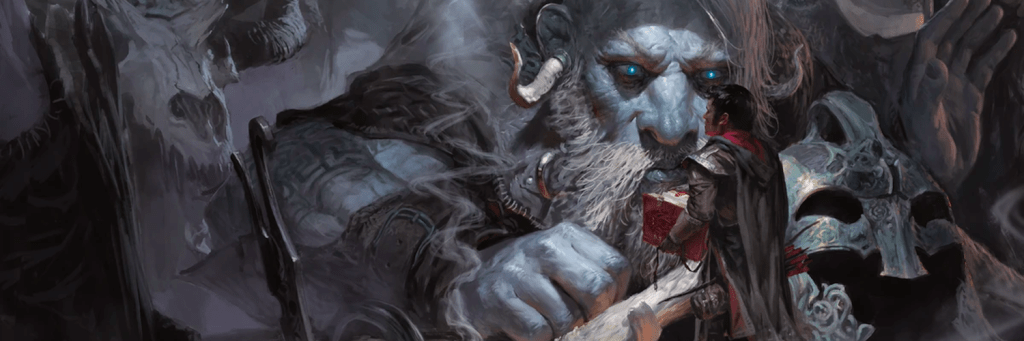
Image credit Volo’s Guide to Monsters by WOTC
3/10/2025
This is the longest article I’ve written to date, so here’s the bottom-line-up-front if you have somewhere to be:
- Our hobby tradition relies on us to grow it.
- As a tradition, it can only grow through mentoring others.
- We need to understand what our hobby is and isn’t to be good mentors.
- We need to study the past to understand what our hobby is.
- I challenge you to bring five new people into the hobby by the end of the year.
The OSR is a Tradition
In recent years, there has been a lot of books, documentaries, and other products about the history of D&D. What it was like back in the day when Dragon magazine was still around, fan-zines were localized, and there was this unified idea of what the hobby was. The Elusive Shift, a book about pre-internet D&D forums (along with other things), pokes a hole in this idea.
“Fundamentally, how were you supposed to play the original dungeons and dragons? What form did the participation of players take? The text, published in 1974, gives us no shortage of rules, with imposing pages of charts and exposition, the books illustrate how to generate characters and underworlds how to dice against tables to derive random encounters, decide random results, and disperse hard-won plunder. But they provide strikingly little instruction on how to integrate those activities into the moment-to-moment play for a game[…] the D&D rules did not [even] instruct players to take turns.”
– The Elusive Shift, Chapter 2
This game is not Monopoly, the rules aren’t straightforward, and even if it was, people would probably still get them wrong (example: Monopoly). The way you learn D&D, or any RPGs for that matter, is by being taught by a mentor, not through impartial learning.
D&D is less of a set-of-rules and of a shared tradition.
The point of this article isn’t to prove that (I think others before me have done that), the point is to tell us what we need to do with that information.
The OSR is a Family Tradition
Around 79% of recruits for the American Army have/had family in the Army. Many out right call it a family tradition. I joined because my mother and father were in the army.
In the army you do cool things. I enlisted as a 92R Parachute Rigger, jumping out of airplanes and rigging cargo chutes. Later I became a field artillery officer, leading sections and platoons of howitzers on fire missions, sending 90lbs payloads downrange using a protractor and compass.
In the army you get great benefits. When my wife was pregnant while I was only a Private First Class, she was cared for in Walter Reed Medical Hospital, the same one the President uses. During my first civil deployment as a 2nd Lieutenant I made over $7,000 a month straight out of college.
And yet, people don’t join unless someone convinces them.
There is a lot of people out there that seem to believe that D&D and the OSR has this gravitational pull and that all people of appropriate virtue will one day take the plunge and join the hobby tradition. Fewer people say that about the OSR than say that about story games, but still, many are saying this.
Traditions, rarely, evangelize and universalize on their own. That’s our jobs as stewards of the tradition.
Traditions are Spread by Mentors
Many gentiles are confused about the use and importance of the Talmud in the Jewish Tradition. It is not a continuation of the Biblical canon (like the Christian New Testament is), but instead a series of opinions and commentaries given by different Jewish thought-leaders throughout history combined into a single book over the course of centuries. It’s the preservation of the greatest perspectives of the greatest Jewish mentors.
Many of them disagree with each other but it’s the reader’s job to come to grips with all these ideas and determine out the intentions of God in your life and the path He wants you to walk. Obviously, there are pre-existing schools of thought, but at the end of the day religious Jews see other religious Jews as religious Jews regardless of the specifics of their practice.
Who are these mentors in the RPG space?
My dad was my D&D mentor. He had me read the everything written by David Gemmell, The Guardian of the Flames books by Joel Rosenburg, the Matador books by Steve Perry, and the Conrad Stargard books by Leo Frankowski. Those were my foundational texts for my games and worldbuilding.
For other people it was an uncle, aunt, older brother or sister, a friend who bought some books and wanted to try out a new game. The weird guy at work or school. The cool guy at work or school (less likely).
But I think for most people, they find their mentorship online.
Critical Role and Mathew Mercer has been the D&D mentor to tens of thousands of people (there’s even jokes in the 5e community about GMs or Players that are too Mercer-like). So has Matt Colville and Ginny Di, and I think in the OSR space its Ben Milton at Questing Beast, Daniel at Bandit’s Keep, Runehammer, Professor Dungeon Master, Bob World Builder, Justin Alexander, and many more.
These folks develop their fan bases reading lists, their roleplay methods, their mission statements, everything like that. People that have the books but lack the mentor latch on to these creators. They are so different from each other, but (for the most part) OSR gamers see other OSR gamers as OSR gamers, regardless of the specifics of their practice.
Our jobs as mentors is get our trainees across the line, not just to get them playing, but to have them want to mentor others as well one day. That’s how a tradition continues.
Mentors Must Know What They Seek to Teach
“Read over and over again the campaigns of Alexander, Hannibal, Caesar, Gustavus, Turenne, Eugene and Frederic. … This is the only way to become a great general and master the secrets of the art of war.”
– Napolean Bonaparte last advice to his newest promoted Marshals
We do not need to create our curriculum from whole cloth. We have the Appendix N from the AD&D Dungeon Master’s Guide, and we have troughs of classic content to replay, like the Tomb of Horrors, Red Hand of Doom, and the original Ravenloft.
How can we hope to be mentors for others, and steward the tradition, if we have not studies ourselves?
But not everything must be in old dusty tomes. As the hobby progressed, so to did our sources of influence. Here’s some more modern works you may have heard of that I would say are part of the revised Appendix N:
- Old School Essentials
- Stonehell Dungeon
- Knave 2e
- Tomb of the Serpent Kings
- Into the Odd
- Rappan Athuk
- Mork Borg
- Maze of the Blue Medusa
Remember, the line of what makes an OSR gamer is broad, there is a lot of room for creativity and growth. Realizing that is part of becoming an informed mentor.
The Next Generation of Mentors
I’m 24 years old, I was not alive when Chainmail, OD&D, BECMI, B/X, AD&D, 2e, or most of the others were being played. I don’t know what that was like. But I’d seen D&D on TV (not the actual D&D TV show, the D&D episodes of shows like Regular Show), I knew it was a thing, I just didn’t know how to play it. When I talked about it with my friends, they didn’t know what I was saying.
“You mean play pretend? That’s for babies, Reese, your 8 now, grow up.”
But I wanted to know. So, my aunt bought me a 4e Starter Set. It was awesome, but I still didn’t know how to play. The numbers, there were so many numbers. And how exactly is this supposed to go again? I think the first time I played the player and the GM took turns describing things. Good news though, I won an award for, “Most Creative Game at the Lock-In” in 5th Grade for my Frankenstein-monstrosity of a board and miniatures I’d put together with the neighbor kids (similarly clueless).
We had fun. But not in the way I’d want to have fun now. It was fun in the way that only kids without responsibilities can have fun. Coincidental.
Then my Dad came into town to visit, and he said he’d played before.
My half-brother, my step-sister, and myself sat down to play my first actual game of D&D and suddenly, it all clicked. I went home and started DMing my own game. Then I wrote a heartbreaker. For a long time, my D&D mentors were Nerdarchy and WebDM. I think they knew they were mentors, even in in the online space.
In my senior year of highschool, I was watching the ItMeJP Westmarches Campaign ran by Steven Lumpkin, and was introduced to the OSR. I bought LotFP soon after. I had no idea how to play it, it was totally different from 4e and 5e (all I’d ever run besides heartbreakers). I found a small YouTuber called IvanMike888. He was my first OSR mentor. Thank you Ivan.
Then it was Questing Beast. Then it was Mathew Colville. Now it’s a whole host of people, or maybe no one in particular. I don’t know. Maybe I outgrew it. Maybe that’s a bad way to think about things.
Recently a few of my buddies I shared the tradition with a long time ago have started running games of their own. They’re asking me for reading lists, game suggestions, and how to handle certain situations at their tables. Whenever we play, we quote movies and books I’ve showed them, but we enjoyed together.
I’m doing my part! I challenge you to do the same!
Thank you for reading!
Until we meet again,
GOOD LUCK ON YOUR ADVENTURES

 Ward Against Evil
Leave a reply to ORIGINS: On Lost Cultures of Play | Taskerland Cancel reply